Writing
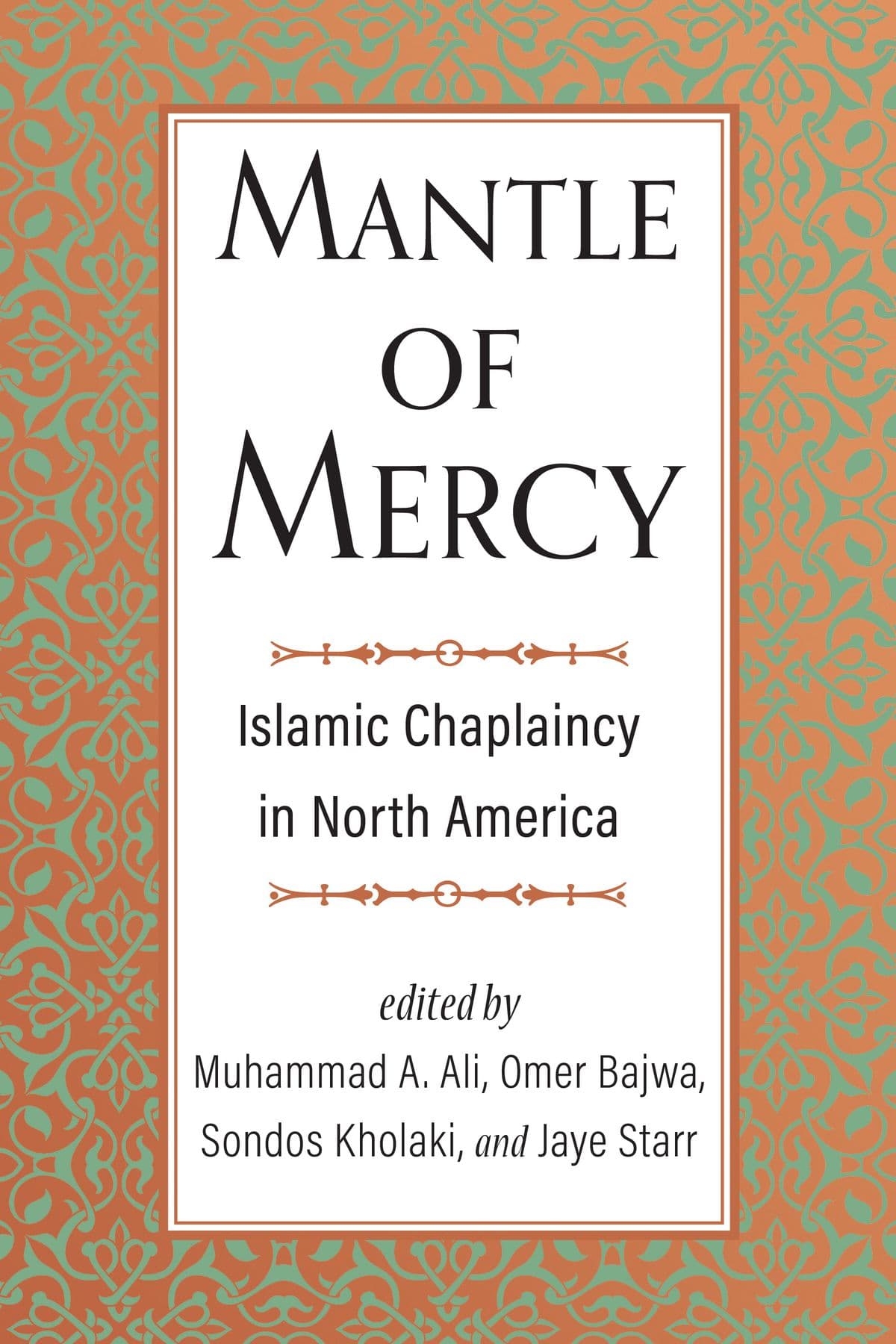
Mantle of Mercy
Islamic Chaplaincy in North America
Thirty essays by Muslim chaplains on their work in universities, hospitals, prisons and the armed forces, the first book of its kind written by the people who practice it. His chapter, “Open Door, Open Heart,” describes the five roles a university chaplain holds at once: spiritual counselor, advocate, interfaith interlocutor, teacher and minister. The book closes with the final sermon and farewell letter of his friend Sohaib Sultan, who urged him not to abandon the project.
“We sit with people, listen to them, and hold their stories. When appropriate, we share those stories.”
Praise
“I really loved this book. Muslim chaplains do amazing work for religious identity, pastoral care, and civic pluralism. This volume captures the complexity and range of such work remarkably well.”
Eboo Patel
“Mantle of Mercy fills an important void within the emerging body of research and writing about the field of chaplaincy.”
Trace Haythorn
“Ali, Bajwa, Kholaki, and Starr have created a watershed moment with the publication of Mantle of Mercy.”
Michael Skaggs
“I commend Ali, Bajwa, Kholaki, and Starr for this urgently needed volume.”
Omid Safi
Reviews
- 2024
- 2023
- 2022
- 2022
- 2022
On the syllabus
- 2023
Chaplaincy: Models and Methods
- 2024
Religious and Cultural Contemporary Ethics for Spiritual Caregivers
- 2025
Foundations and Practice of Chaplaincy
Cited in more than fifteen scholarly works, including the Oxford Research Encyclopedia of Religion.
Essays and articles
In print
- 2026
Consider This: reflections for the Yale community
Weekly meditations he has contributed to the Chaplain’s Office series, drawing on Hafez, Rumi, Ramadan, generosity and courage.
- 2025
A tribute to Imam Sohaib Sultan: a life of grace, joy, and service
Remembering Princeton’s first full-time Muslim chaplain, who preceded him at Yale and urged him to finish Mantle of Mercy.
- 2022
A college chaplain reflects on his roles through the days of the week: spiritual counselor, advocate, interfaith interlocutor, teacher and minister.
- 2020
On keeping the month in lockdown, written in its first pandemic spring.
- 2017
- 2016
On pluralism as a practice rather than a slogan.
- 2009
- 2006
A Rhetorical Analysis of Hamza Yusuf’s Discourse on Education
Cited in Walaa Quisay’s Neo-traditionalism in Islam in the West (Edinburgh University Press, 2023).
- 2002
Negative Media Coverage of Islam
On anti-Islamic rhetoric and representations of jihad in the Western press before September 11th, as described by the Cornell Chronicle.
Cited in scholarship
2026
Cites a chapter of Mantle of Mercy.
2025
Cites the book as the work that links theory and practice in the field.
Prophetic model of Islamic spiritual care from Muslim professional practitioners’ perspectives
A systematic review that examines two of the book’s chapters.
Angelic care: exploring the angel Jibril as a model of Muslim pastoral care
Cites the book and names him.
Chaplaincy and Spiritual Care in the Twenty-First Century, reviewed
Points readers to the stories collected in Mantle of Mercy.
2024
Eine muslimische Perspektive auf Spiritual Care: Herausforderungen und Chancen
A German chapter on Muslim spiritual care that cites the book.
Living the Muslim-enough reality as a Muslim woman chaplain
Cites the book.
The Devotional Qur’an: Beloved Surahs and Verses
Thanks him in the acknowledgments for years of support on the translations.
Mapping Muslim chaplaincy: an analytic review of publications between 1989 and 2023
Cites the volume and five of its chapters.
Religious diversity and university chaplaincy
Draws on his account of the origins of Muslim chaplaincy in the United States.
2023
Neo-traditionalism in Islam in the West
Cites his Cornell master’s thesis, A Rhetorical Analysis of Hamza Yusuf’s Discourse on Education (2006).
2017
Acknowledged among the friends who supported the work at Yale.
2015
Looking for leadership: discovering American Islam in the Muslim chaplaincy
A chapter built around interviews with him in 2011 and 2014.
2014
Acknowledged for help obtaining difficult sources.